Wolf Range Burner Won't Light — A Del Mar Case Study on Spark Module Failure
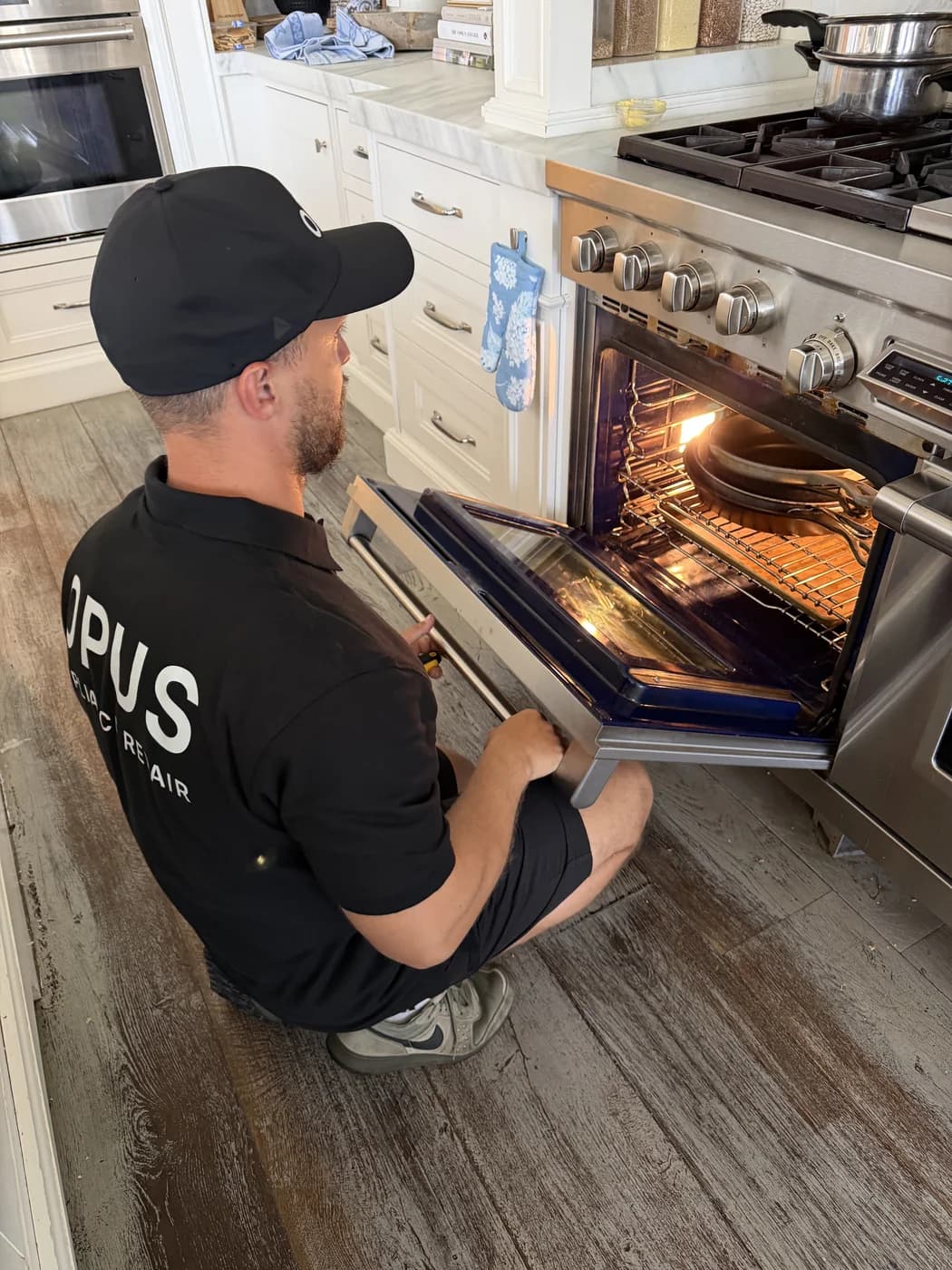
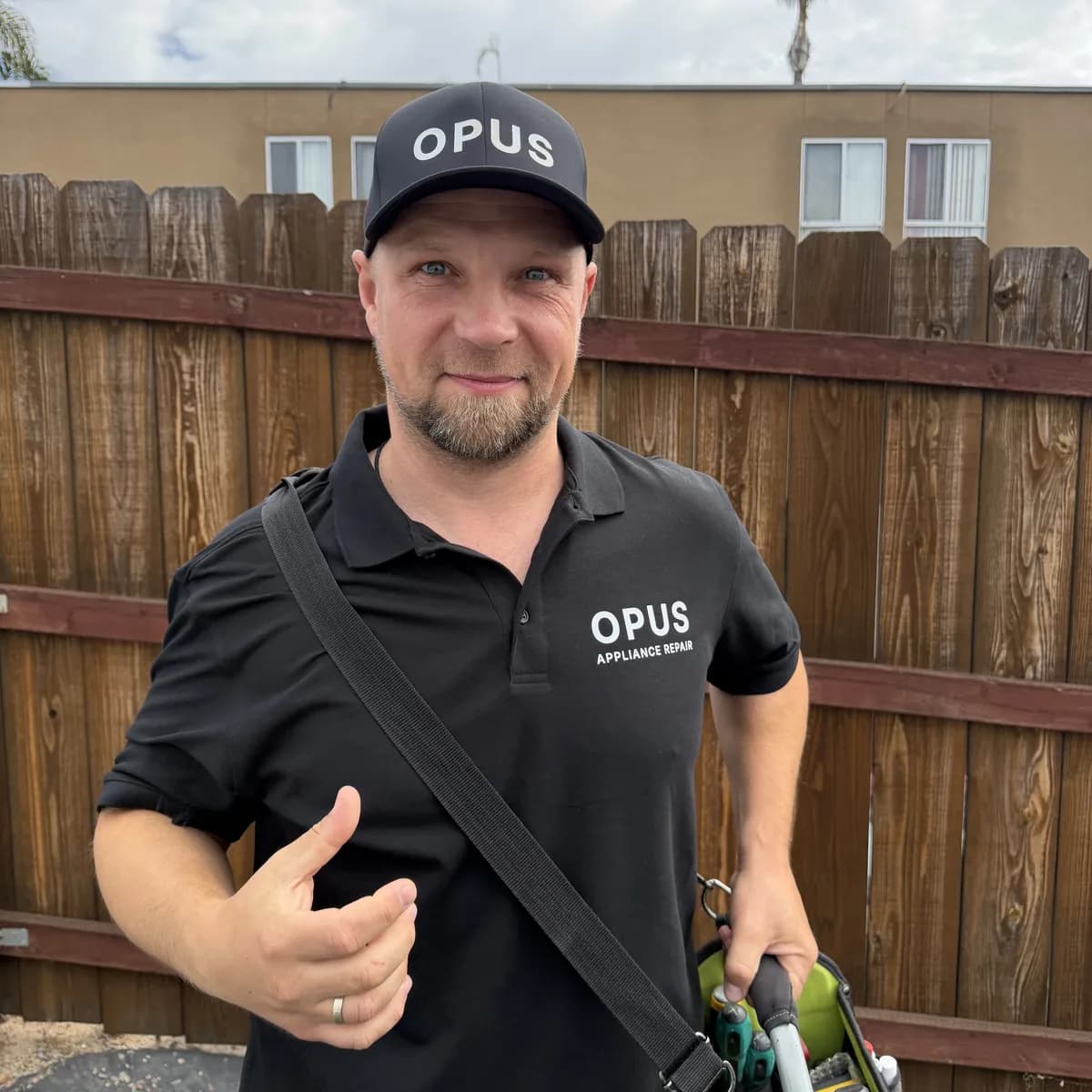
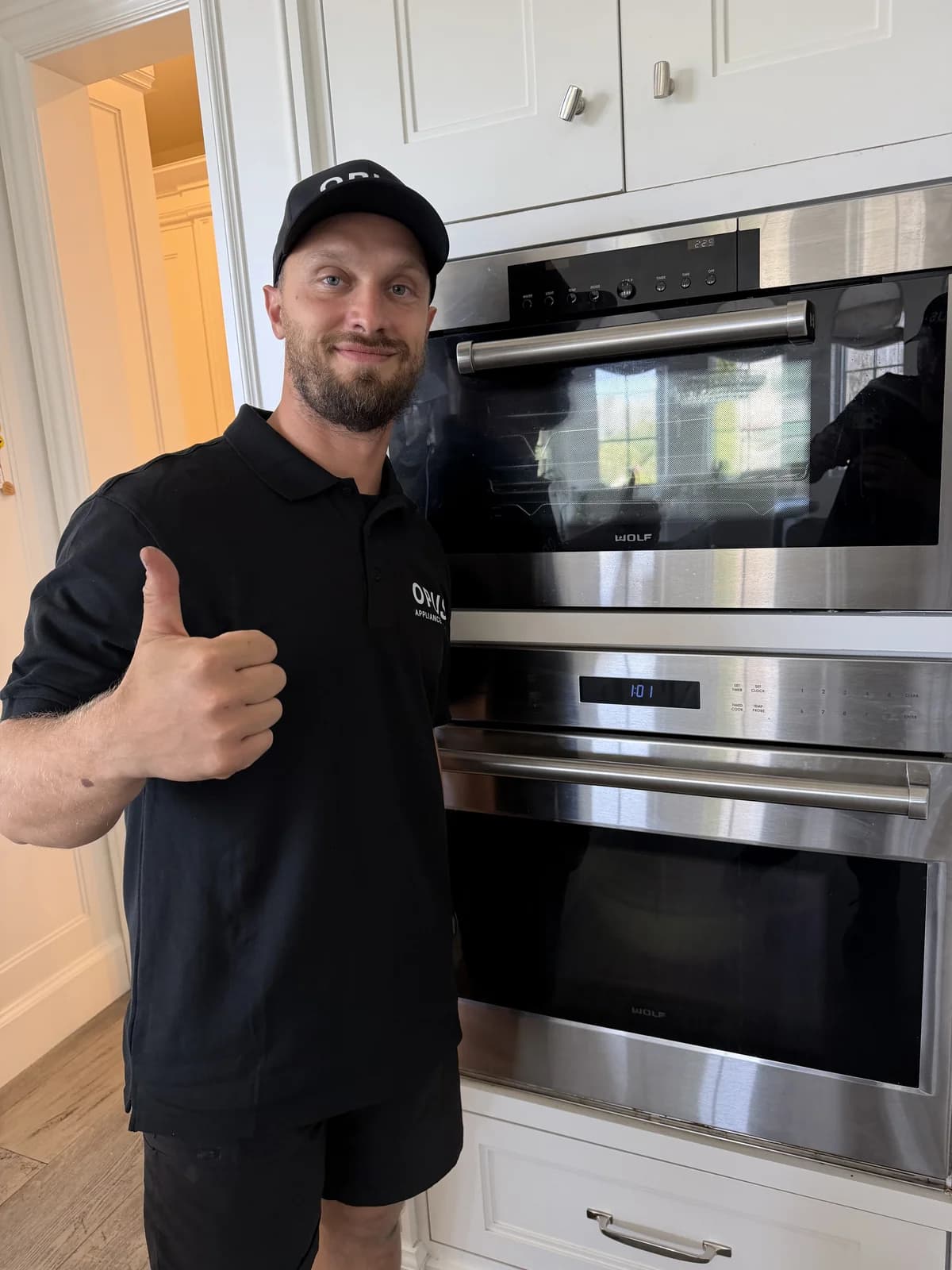
The repair process: arrival, accessing the burner assembly, and diagnostic testing on the spark module.
Friday Afternoon, 36 Hours Before the Dinner Party
3:47 PM on a Friday. The homeowner had eighteen people coming over for Saturday dinner. Her <a href="/brands/wolf">Wolf</a> 36-inch dual-fuel range — the centerpiece of a kitchen renovation finished three years earlier — had two burners refusing to ignite. The front-left 18,000-BTU burner clicked rapidly when she turned the knob but produced no flame. The rear-left 9,200-BTU burner stayed silent — no click at all. She'd noticed a brief gas smell on the front burner attempt, killed everything, and opened the windows. Smart move.
Two burners failing at once on a Wolf range narrows fast to three causes: a shared spark module that supplies the failing pair, a degraded igniter switch on one burner, or a gas-pressure issue feeding that side of the manifold. The split symptom — one clicking weakly, the other dead silent — pointed at two separate faults, not one shared cause. That's a specific pattern we see on Wolf ranges between year 8 and year 12, and <a href="/areas/del-mar">Del Mar</a>'s salt air pushes that window earlier than inland.
Why Two Wolf Burners Fail at Once (and Why They're Different Failures)
The Wolf DF36450 is not a commodity range. It's an $8,000–$12,000 dual-fuel platform — gas cooktop on top, electric convection oven below — with sealed brass burners and a cast-iron grate system that's removable for cleaning. Each burner has its own dedicated igniter switch (the rotary contact behind the knob), and the burners are wired in pairs to spark modules — small high-voltage transformers tucked under the cooktop that generate the spark across the electrode.
Most general appliance techs miss this two-tier architecture. They'll see two burners not lighting and assume one cause. On a Wolf, you have to test the switch and the module independently, because a failed switch on one burner and a failed module on a paired burner produces exactly the symptom this homeowner described — one clicks but won't light (switch sending signal, module weak), the other does nothing (switch dead, no signal sent at all).
Wolf <a href="/stove-range-repair-san-diego">range repair</a> Del Mar homeowners deserve a diagnostic path that respects this design — not a generic "replace everything" verdict. The DF36450 has predictable failure patterns at the 8–12 year mark, and igniter hardware is at the top of that list, especially in coastal homes where salt air accelerates electrical contact corrosion.
On the Truck: Spark Module vs Igniter Switch Tests
Our technician Andrew arrived within two hours of the call. The first step was confirming gas line integrity — pulling the range forward gently on its leveling feet, checking the flexible gas connector and shut-off valve. Pressure tested fine at 7 inches water column for natural gas, which is the Wolf spec. So gas supply was not the problem.
Using a multimeter set to continuity, Andrew tested each igniter switch by rotating the knob and watching for circuit closure. The front-left switch was making intermittent contact — fine when first turned, but losing continuity within a couple of seconds. That explained the clicking-without-flame symptom: the spark module was getting a brief signal, firing once or twice, then losing the trigger. The rear-left switch tested completely dead — no circuit closure at all, regardless of knob position. Two distinct failures on two adjacent burners.
Next, Andrew bypassed the failed switches and tested the spark modules directly with bench voltage. The front module fired weakly — degraded but still functional. The rear module fired strongly. So the front-burner pair had a switch problem AND a weakening module, while the rear-left was a clean switch failure.
On Wolf DF-series ranges, the igniter switches sit on a sub-chassis behind the front fascia and are accessed by pulling the cooktop forward. Each switch is rated for roughly 25,000 cycles. On a heavily used range — a household that cooks 5–7 times a week — switches typically reach end of life around year 8–10. This particular range was a 2014 install, putting it right in the expected failure window.
Salt-Air Math: Why Del Mar Wolf Ranges Burn Through Igniters Faster
A Wolf igniter switch is a small rotary contact that closes a circuit when you turn the burner knob. Each cycle creates a brief electrical arc as the contacts make and break — the same physics that wears out any rotary switch. Over thousands of cycles, the contacts pit, oxidize, and lose conductivity. The pattern is highly predictable: years 1–5 the switch is solid, years 6–8 it shows occasional intermittency, years 9+ it begins failing in earnest.
Coastal homes accelerate this. Salt-laden air gets into every appliance — the Del Mar coastline is notoriously aggressive on electrical contacts. A range that might last 12 years inland reaches end-of-switch-life at year 8 in a coastal home. We see this often in Del Mar, <a href="/areas/la-jolla">La Jolla</a>, and <a href="/areas/coronado">Coronado</a>.
Modules fail differently — the high-voltage transformer windings degrade from heat and moisture cycling. A weakening module produces dim, intermittent sparks instead of the strong rapid clicks of a healthy unit. By the time a homeowner notices, the module typically has 6–12 months left before complete failure, and replacement is the right call rather than waiting.
The 90-Minute Repair
Wolf OEM parts run higher than mass-market — the front-left igniter switch (Wolf part #809655) is roughly $85 and the front spark module (#809651) is around $145. We carry these on our service vehicles for exactly this scenario. Replacing both at once made sense: the homeowner wasn't going to pay another diagnostic for the module's eventual failure, and it would prevent another service call within a year.
The full replacement took approximately 90 minutes:
- Disconnected the dedicated 240V oven circuit and confirmed zero voltage at the control board with the multimeter
- Shut off the gas supply at the wall valve and confirmed no flow with the upstream test port
- Removed the cast-iron grates, all six brass burner caps, and the cooktop trim ring
- Pulled the cooktop forward on its hinges to access the switch sub-chassis behind the front panel
- Disconnected the failed front-left and rear-left switches, replaced both with OEM Wolf #809655 units, and installed the OEM #809651 spark module in the front-left harness
- Reseated all wiring, replaced the cooktop, restored gas, and powered up at the breaker
- Tested all six burners — every one fired instantly on first click, with steady blue flame and no yellow tipping
- Cleaned the cast-iron grates while we had them apart — complimentary, since they were already off
Within minutes the cooktop was back in service. Andrew verified the flame quality on each burner with the homeowner watching, walked her through the diagnostic process, and printed an invoice with both Wolf part numbers for her records. The $80 diagnostic fee was applied against the final repair total. The repair was covered by our 90-day parts-and-labor guarantee, and the homeowner had her dinner party set up for Saturday.
Six Self-Checks Before You Pay for a Diagnostic
Before booking anyone for a Wolf range that won't ignite, a few quick checks separate the easy fixes from the actual hardware failures. These are the signs that point strongly to igniter or module failure on a Wolf DF or M-series range older than 7 years:
- Listen to the click. A healthy Wolf burner clicks 8–10 times per second — rapid and steady. Slow or sporadic clicks suggest a degraded switch or weakening module.
- Watch in dim light. Turn off the kitchen lights and try to ignite. A healthy spark electrode produces a visible blue arc at the burner head. No spark = module dead or switch not signaling.
- Smell test. A brief gas smell when a burner fails to ignite is normal — gas is flowing, just not lighting. A persistent or strong gas smell is a signal to STOP. Turn everything off, ventilate, and call a professional.
- Check multiple burners. If two burners on the same side fail at once, suspect a shared module. If only one fails, suspect that burner's individual switch.
- Note the age. Wolf ranges in coastal homes (Del Mar, La Jolla, Coronado, Cardiff) reach end-of-igniter-life around year 8. Inland homes (Poway, Escondido, San Marcos) push it to year 10–12.
- Try unplugging for 5 minutes. Soft control-board faults clear with a power cycle. If the problem returns within minutes of restoring power, it's a hardware issue.
If three or more of these checks point to igniter or module hardware, a $80 diagnostic visit gets you a precise verdict and an OEM-parts quote, applied toward the repair if you proceed.
Coastal Wolf Service Notes: What We See in Del Mar Specifically
Del Mar is one of our most active service areas — between the homes along Camino Del Mar and the older properties around the racetrack and <a href="/areas/solana-beach">Solana Beach</a> line, we see Wolf 36" and 48" ranges (DF and M series) regularly. The 2010–2020 install era is now hitting the 6–12-year mark, which is exactly when igniter switches and spark modules begin failing. Coastal salt accelerates this — we typically see Wolf ranges in Del Mar needing igniter service 2–4 years sooner than the same model inland.
We're a locally owned shop, serving San Diego homeowners since 2016. Our technicians are factory-certified for Wolf, and we stock OEM igniter switches, spark modules, and the most common Wolf burner caps on our service vehicles. For most appointments in Del Mar, same-day service is realistic if you call before noon.
Every repair we do is backed by our 90-day parts-and-labor guarantee. If the same fault returns within 90 days, we come back free of charge — no second diagnostic, no negotiation. That's the point of standing behind a repair.
When to Stop Trying and Call
A Wolf range that struggles to ignite is a fixable problem — but the longer it sits, the more likely it is to become a multi-failure replacement. Here are the signs that point to professional service rather than a DIY fix:
- Burner clicks but won't light, even after multiple knob attempts
- Two or more burners on the same side affected at once
- Persistent gas smell — stop, ventilate, and call immediately
- Yellow flame tips instead of clean blue cones (gas-air ratio off)
- Cooktop is more than 7 years old in a coastal area
- Cleaning the burner cap and electrode with a wire brush didn't help
Wolf igniter and spark module replacement is a precision job — getting the harness routing wrong, over-torquing the cooktop hinges, or installing aftermarket parts can damage the control board or void the manufacturer warranty if any remains. The OEM parts cost more, but they're matched to the exact spark voltage spec for each generation of Wolf range, and they last.
Repair Summary
- Appliance: Wolf DF36450 — 36" dual-fuel range
- Problem: Two burners failing to ignite — switch + module fault
- Solution: OEM igniter switch (#809655) + spark module (#809651)
- Time on-site: ~90 minutes (diagnosis + repair + testing)
- Location: Del Mar, San Diego
- Warranty: 90-day guarantee on parts and labor
Related Reading
If this case study was useful, a few other guides cover adjacent Wolf and high-end range topics:
Wolf range refusing to light? Our factory-certified technicians carry OEM Wolf igniter switches and spark modules on the truck, and most Wolf range repairs in Del Mar are completed same-day. Flat $80 diagnostic credited toward the repair, 90-day guarantee on parts and labor.
(858) 788-7973