Thermador Oven Not Heating — What's Wrong and How to Fix It
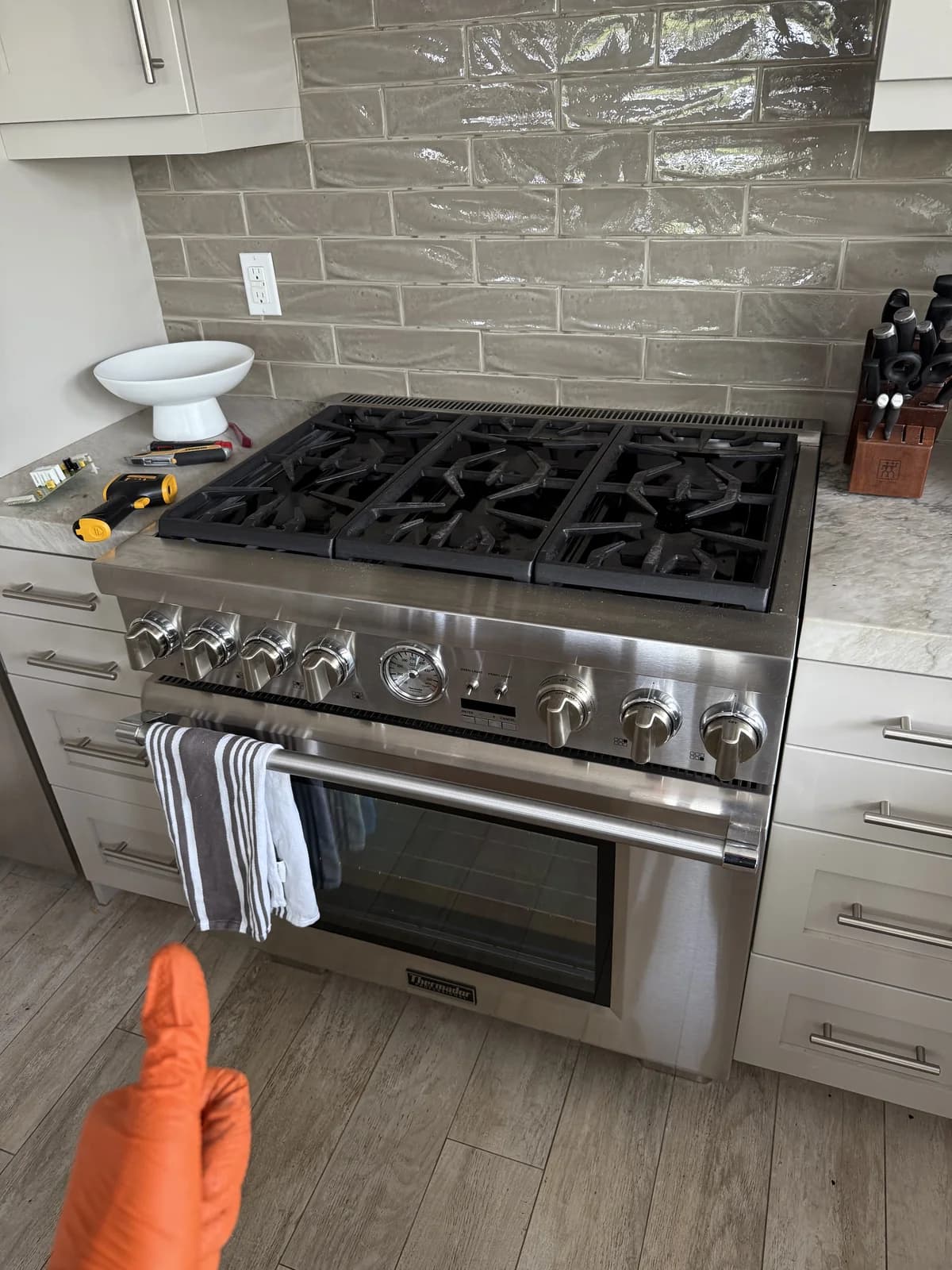
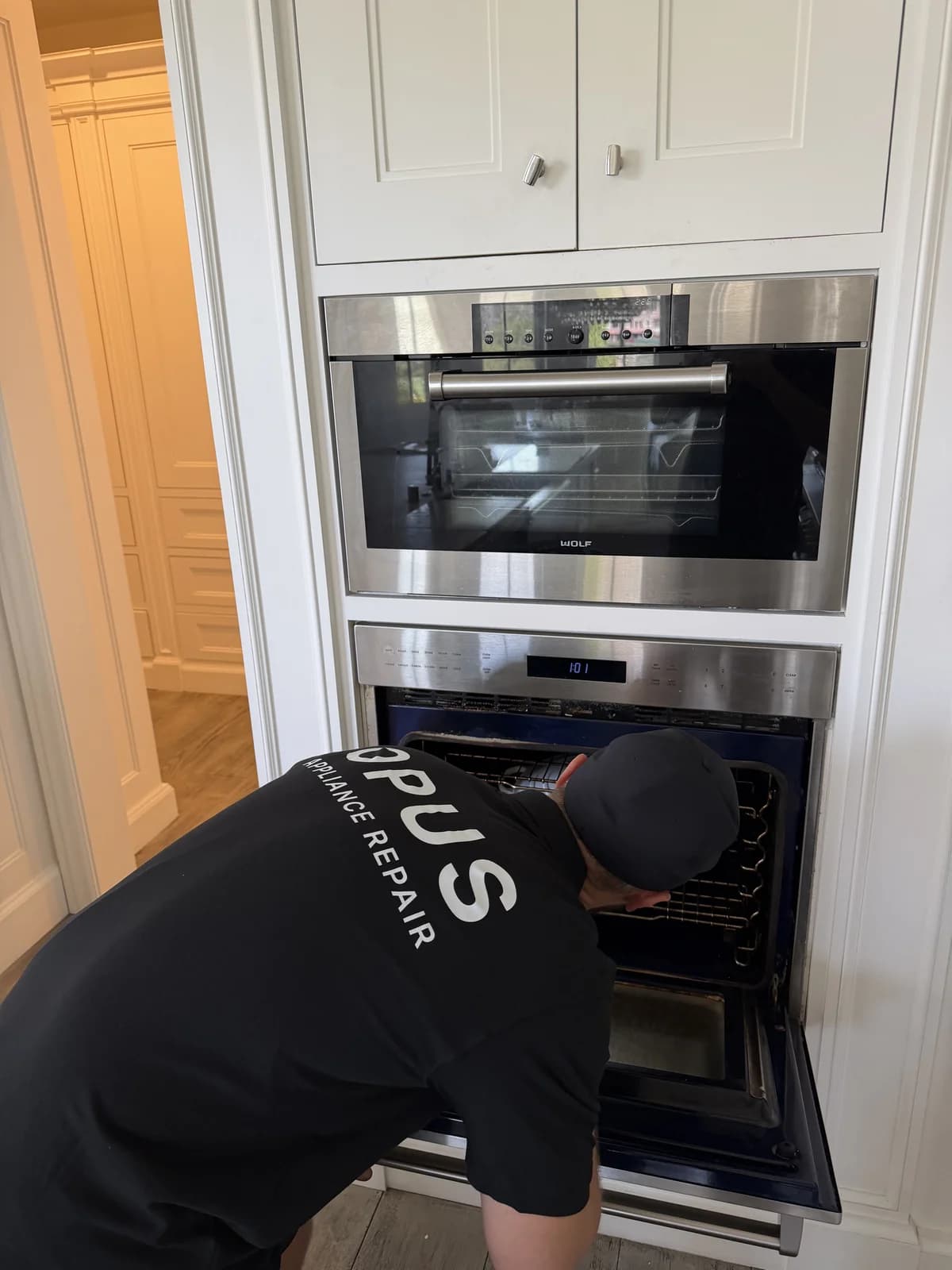
Diagnosing a Thermador heating fault: oven inspection, igniter/element check, and sensor multimeter testing.
Your Thermador Oven Not Heating Up?
You set the temperature, preheat starts, but the oven never reaches the target temperature — or it doesn't heat at all. This is one of the most common issues we see with both gas and electric <a href="/brands/thermador">Thermador</a> ovens. The good news: in most cases, there's a clear cause, and a certified technician can diagnose it quickly.
The symptoms vary. Some Thermador ovens will preheat to 200°F and stall there, chasing the setpoint but never climbing. Others throw an F-code on the display and shut down mid-bake. A third pattern: the oven claims to be at 375°F, the display looks normal, but a roast is raw 45 minutes in — the sensor is lying to the control board. Each symptom points to a different fault, which is why a proper diagnosis matters more than a parts-swap guess.
Here's what you need to know about why your Thermador oven not heating up, and when you can check it yourself versus when to call for professional repair. We'll walk through the five causes we see most often in San Diego kitchens, the quick checks you can run yourself without tools, and what a diagnostic visit actually looks like when you book one.
Why Your Thermador Oven Won't Heat Up
1. Faulty Igniter (Gas Models)
On gas Thermador ovens, the igniter glows to heat a bimetal element that opens the gas valve. If the igniter is weak or has failed, it won't get hot enough to trigger the valve opening, so no gas reaches the burner.
This is the most common cause of a Thermador oven not heating up on gas models. The igniter may glow visibly but fail to reach the 1200–1400°F needed to open the valve. After 3–5 years, igniters wear out and need replacement.
Tell-tale sign: you hear the click-click of the spark, then see a dim orange glow at the base of the oven, but never hear the whoosh of ignition. That's a glow-bar on its way out. A healthy igniter reaches full brightness in 30–60 seconds and triggers the valve within 90. Parts typically run $140–$220 plus labor, and the whole swap is under an hour on a Pro-series oven.
2. Defective Heating Element (Electric Models)
Electric Thermador ovens rely on a bake heating element (at the bottom) and broil element (at the top). When either burns out, the oven won't reach temperature in that mode. You may see visible breaks or blistering on the element itself.
Heating elements are non-repairable — they must be replaced. A burned-out bake element is why your Thermador oven not heating up evenly or at all.
Quick visual check: look into the cold oven with a flashlight. A good bake element is a uniform dark grey coil. A bad one has a visible break, a bubble, or a scorched spot. If the element glows unevenly — bright red on one side, dim on the other — it's about to fail even if it's still producing some heat. Swapping the element takes 30–45 minutes of labor.
3. Temperature Sensor Malfunction
The temperature sensor (often called a thermostat or RTD probe) tells the oven's control board what temperature has been reached. If it reads incorrectly, the oven may shut off too early or never reach target temperature.
A failing sensor typically reads higher than actual temperature, causing the oven to cut off heat prematurely. You can test it with a multimeter: the resistance should be around 1,080 ohms at room temperature (70°F).
Diagnostic clue: sensors fail silently. The display reads the target, the element glows like it should, but your cooking tells the truth — cakes don't rise, roasts come out raw, bread browns unevenly. If you've recently replaced an element and the problem persists, the sensor is the next suspect. An OEM Thermador RTD runs $60–$140 and installs in about 20 minutes from the rear of the oven.
4. Control Board Failure
The electronic control board sends the signal to heat the oven. If it fails or its relay shorts out, the igniter or heating element won't receive power. You'll often see error codes or erratic behavior on the display.
Control board failures usually require professional diagnostics using specialized equipment.
Common F-codes: F1 and F7 typically point to a relay or shorted keypad; F2 is temperature-related (often sensor or board, depending on context); F31 on newer Masterpiece ovens flags a communication fault between the main board and the display. Don't just reset the breaker and call it done — a flagged board will re-throw the code within a few bakes, and the underlying relay may fail catastrophically the next time it cycles. Boards run $350–$650 in parts.
5. Gas Supply Issues (Gas Models)
Sometimes the simplest explanation is the right one: the gas valve may be off, the flex line kinked, or the gas pressure too low. Check that your gas supply is on at the wall, and look for any visible obstructions in the line.
Also worth checking: did the problem appear right after a plumber, remodel, or range move? Shut-off valves get bumped closed without anyone noticing. Run a stove-top burner to confirm gas is actually flowing to the appliance — if the cooktop lights normally but the oven refuses, the issue is inside the oven, not in the supply line.
Can You Fix a Thermador Oven Yourself?
Thermador ovens are high-end appliances with precision engineering. Most heating issues require professional repair for safety and warranty reasons.
What you can check yourself:
What you should not try: Testing igniter voltage, removing the heating element, opening the control board, or testing gas flow. These require specialized tools and carry electrical or gas hazard risks.
- Gas supply is on at the wall valve
- Circuit breaker for the oven hasn't tripped
- Self-clean lock isn't engaged (which disables the oven)
- Condenser coils aren't clogged with dust (for convection models)
How Professional Thermador Oven Repair Works
When you call OPUS, here's what our certified technicians do:
Most heating repairs cost between $200–$500, depending on the part. Your $90 diagnostic fee is applied toward the repair cost, and we back all work with our 90-day guarantee.
- Multimeter diagnostics: We test igniter resistance, heating element continuity, and sensor readings to pinpoint the problem
- Gas pressure testing: For gas models, we verify gas pressure is within Thermador specifications
- OEM parts only: We use genuine Thermador replacement parts to maintain the oven's performance and warranty
- Calibration: After repair, we calibrate the oven temperature to ensure it heats accurately
Thermador Oven Heating Repair Summary
- Most common cause (gas): Weak or failing igniter
- Most common cause (electric): Burned-out bake heating element
- DIY diagnostic possible: Check gas supply, circuit breaker, self-clean lock
- Professional repair required: Igniter, heating element, sensor, or control board replacement
- Thermador oven not heating up repair time: 1–2 hours on-site (diagnosis + repair)
- Warranty: 90-day guarantee on parts and labor since 2016
Common Thermador Models and Their Quirks
Each Thermador oven line has its own failure pattern. Knowing which you own narrows the diagnosis.
- Pro Grand (PRD, PRG): 48- and 60-inch dual-oven ranges. Heavy-duty igniters fail fully rather than slowly. Sensor faults are more common than board faults on these.
- Pro Harmony (PRL, PRD-P): 30- and 36-inch home-pro ranges. Smaller cavity, faster heat-up — but igniters cycle more often. Plan on glow-bar replacement every 4–6 years with regular baking.
- Masterpiece (ME, MED): built-in electric wall ovens. Bake-element failure leads, followed by convection fan issues. The softer touch panel tends to develop membrane faults after year 8.
- Older wall ovens (POD, POM, pre-2015): still common in San Diego homes. Parts are harder to source — OEM orders can add 3–5 business days if we don't have the item on the truck.
- Dual-fuel ranges: gas cooktop with electric oven. If the oven side dies, the gas side still works — it's a straight electric-oven diagnosis, not a full range replacement.
Before You Call — A 60-Second Self-Check
About 15% of the calls we take turn out to be one of these:
If none of those applies, book a diagnostic. Our flat $90 fee covers the multimeter test and written quote, and the $90 comes off the repair bill if you proceed.
- Self-clean lock engaged. Door still locked from a cleaning cycle that never finished. Wait for cool-down, then hold the cancel button 5 seconds.
- Timed-bake or delayed start active. Display looks normal, oven sits cold. Check for a "delayed start" indicator.
- Half-tripped circuit breaker. Display runs on 120V, elements on 240V. One tripped leg kills heating but leaves the clock alive. Flip the breaker fully off, then back on.
- Gas shut-off partially closed. Passes enough gas for a cooktop burner but not for a 22,000-BTU oven burner. Test with a cooktop burner first.
- Sabbath mode. Rare — the oven appears on but ignores temperature changes.
Preventing Thermador Oven Heating Issues
Keep your oven running reliably with these simple steps:
- Annual maintenance: Have a technician inspect the igniter, element, and sensor every 2–3 years
- Don't block air vents: Thermador ovens need airflow around the perimeter — don't place cookbooks or foil against the rear vent
- Clean condenser coils: Dust buildup on the condenser (on convection models) reduces heating efficiency. Clean them once a year
- Calibrate temperature: Every 1–2 years, verify your oven temperature with an independent oven thermometer and call for recalibration if it's off
Thermador Oven Not Heating? Call OPUS Today
Your Thermador oven is built for performance. When it stops heating, you need a technician who understands high-end appliances. OPUS has been serving San Diego homeowners since 2016 with factory-certified Thermador repair. We diagnose the problem quickly, use OEM parts, and guarantee our work for 90 days.
Thermador oven not heating up? Don't risk gas leaks or electrical issues. Our certified technicians repair Thermador ovens same-day across San Diego.
OPUS Appliance Repair — factory-certified Thermador specialists serving San Diego since 2016. Every visit starts with a $90 diagnostic fee (applied toward your repair). All work backed by our 90-day guarantee. Call (858) 788-7973.
Factory-certified appliance repair trusted across San Diego County.
- Sub-Zero
- Wolf
- Thermador
- Miele
- Viking
- Bosch
- KitchenAid
- Jenn-Air
- Fisher & Paykel
- GE Monogram
- Dacor
- Electrolux
- Cove
- ASKO
- U-Line
- Bertazzoni
- BlueStar
- Refrigerator Repair
- Oven Repair
- Dishwasher Repair
- Washer Repair
- Dryer Repair
- Range Repair
- Cooktop Repair
- Wine Cooler Repair
- Freezer Repair
Heating-Element Failures Across Other High-End Ovens
The bake-element, igniter, and thermostat diagnostic order applies to every high-end oven brand we service. <a href="/brands/wolf">Wolf</a> DF and M-series ovens use a similar broiler-element + convection-fan architecture — same failure modes at year 8-12. <a href="/brands/miele">Miele</a> H-series wall ovens have PerfectClean catalytic interior plus PowerCook tech, but the heating-element diagnostic is the same. <a href="/brands/viking">Viking</a> Professional ovens and <a href="/brands/dacor">Dacor</a> Modernist ranges share similar igniter assemblies on the gas side.
<a href="/brands/bluestar">BlueStar</a> open-burner ovens are the outlier — hand-built American components mean less standardization, but the diagnostic principles are identical: test element resistance, check igniter timing, verify control-board signaling. Our <a href="/oven-repair-san-diego">oven repair service</a> covers Thermador and the rest across <a href="/areas/la-jolla">La Jolla</a>, <a href="/areas/rancho-santa-fe">Rancho Santa Fe</a>, <a href="/areas/del-mar">Del Mar</a>, and <a href="/areas/coronado">Coronado</a>.
Thermador Oven Not Heating — Quick Reference
- Gas oven, no flame: Most likely failed igniter — quoted at diagnostic
- Electric, weak/no heat: Bake or broil element burnout
- Heats wrong (too hot/cold): Temperature sensor or thermostat fault
- Random shut-off / error code: Control board issue — pro repair only
- DIY safety rule: Always disconnect power/gas first; gas work = pro only
- Service signal: Any gas smell or repeated error → call OPUS, do not self-fix
Related Reading
If your Thermador issue extends beyond a heating fault, these companion guides cover the most common follow-ups.
If your Thermador oven still won't heat after the basic checks — or if there's any sign of gas, a burning smell, or an error code — stop and call. Our factory-certified technicians complete most Thermador oven repairs same-day. Flat $90 diagnostic credited toward the repair, 90-day guarantee on parts and labor.
(858) 788-7973