How to Clean a Dryer Vent — A San Diego Technician's Walkthrough
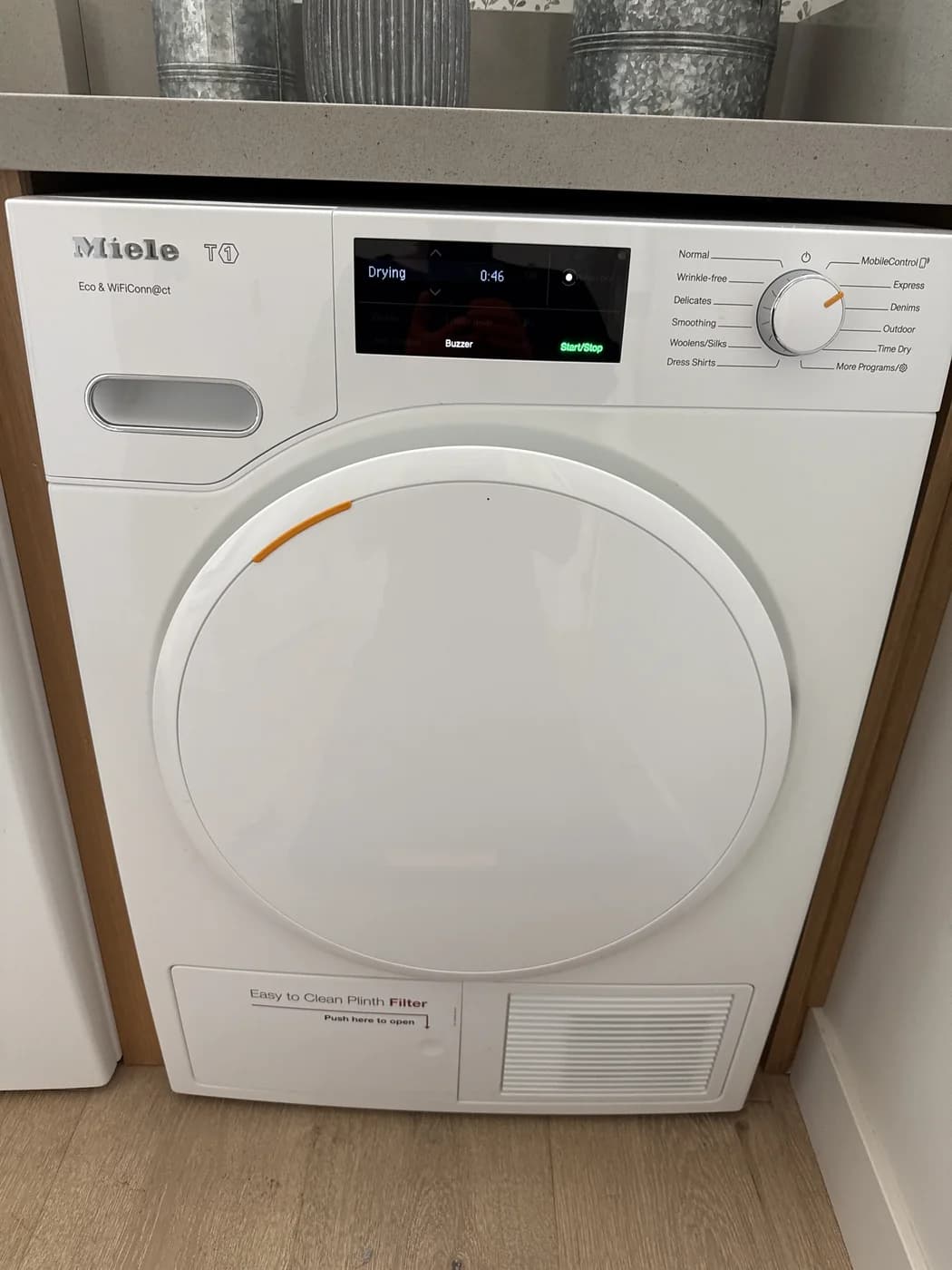

Heat-pump dryer condenser unit and secondary lint filter — the part most homeowners never see.
Four Pounds of Lint and a Two-Year-Old Dryer
Last month I pulled four pounds of lint out of a dryer vent in <a href="/areas/encinitas">Encinitas</a>. The dryer itself was two years old — a <a href="/brands/miele">Miele</a> T1 heat-pump unit installed during a 2024 laundry renovation. The homeowner had called because dry cycles were running an hour and forty minutes instead of the forty-five they were used to. She'd been emptying the lint trap every load, like she was supposed to. The problem wasn't the trap.
Lint trap catches the obvious fluff. The vent — the metal duct that runs from the back of the dryer to the exterior of the house — catches everything else. Fabric fibers, microscopic enough to slip past the screen, pet hair, dryer sheet residue. Two years is enough time for that buildup to choke airflow. By the time clothes start taking twice as long to dry, the vent is usually 60–80 percent restricted. That's also the danger zone — the National Fire Protection Association links clogged dryer vents to roughly 15,000 house fires in the US every year, mostly because superheated lint inside a starved vent eventually ignites.
This piece is what I'd tell you if you called and asked whether you can clean your own dryer vent. The short answer is yes, most homeowners can. The longer answer depends on your dryer type, your home layout, and how long it's been since the last service. I'll go through all of that.
How to Read Your Dryer's Symptoms
Before I tell you what to do, here's how to tell if you need to do it. Dryer vents don't fail suddenly — they degrade. Watch for the pattern, not a single sign.
If you see three or more of these on a vented dryer, the vent is restricted. If your dryer is a ventless heat-pump unit (Miele T1, <a href="/brands/bosch">Bosch</a> 800-series ventless, Asko, <a href="/brands/fisher-paykel">Fisher & Paykel</a> ventless), some symptoms apply differently — see the brand-specific section below.
- Dry cycle takes 30+ minutes longer than it used to for the same load size
- Dryer exterior is hot to the touch within 10 minutes of starting
- You smell hot lint or a faint burning odor during operation
- Lint is accumulating on the floor near the dryer or visible at the exterior vent hood
- The exterior vent flap doesn't fully open when the dryer runs
- You hear airflow through the vent but feel weak air at the exterior hood
How Often to Actually Service It
Manufacturer recommendations are usually annual. Real-world cadence depends on usage. Most San Diego households I service run somewhere between these ranges:
Andrew, who handles a lot of north-county dryer calls, has a rule: if you can't remember when the vent was last cleaned, it's been too long. Typical San Diego homes go 2-4 years between cleanings, which is usually fine — but the homes pushing 5+ years are the ones we get fire-scare calls from.
- Light use (2 loads/week, no pets, short vent run): every 18-24 months
- Moderate use (3-5 loads/week, pets that shed): every 12 months
- Heavy use (daily loads, multiple shedding pets, long-haired family members): every 6 months
- Rental properties or homes with multiple-family laundry: every 4-6 months
- Rooftop vents in any usage scenario: annually minimum, regardless of load count
Tools That Actually Matter
You don't need professional gear for a standard vent clean. You need a flexible vent brush kit, a vacuum with a hose attachment, a screwdriver, and a flashlight. Hardware stores sell the brush kits in $20-$40 range. The kits with drill-attachment ends work faster for stubborn buildup; the manual rod kits work fine for annual cleaning on shorter runs.
One thing I don't recommend: don't use a shop-vac as your only tool. Shop-vacs clog quickly with fine lint, and a clogged shop-vac running for 10+ minutes gets dangerously hot. Use the vacuum for the cleanup pass, not the cleaning pass. The brush does the cleaning. The vacuum picks up what the brush dislodges.
Leaf blowers are useful for one specific case — long vent runs (25+ feet) where the brush won't reach all the way through. Position the blower at the exterior hood end on low setting and blow air backward through the duct toward the dryer. This pushes loose lint inside, where the vacuum picks it up at the dryer end. We use this method on roughly a third of the homes we service in San Diego.
Cleaning from the Dryer Side (the Easier Half)
Start at the dryer because it's the safer access point — no ladders, no roof, no exterior wall to contend with. This part is a 30-minute job for anyone comfortable pulling the dryer out.
First, kill power. Unplug the dryer at the outlet. If it's a gas dryer, shut the gas valve on the wall behind the unit (handle perpendicular to the line means closed). Don't trust the outlet alone on a gas unit — gas line stays pressurized and you can leak product even with the dryer off.
Second, pull the dryer forward. Most pull out 12-18 inches without disconnecting the gas or vent — enough to reach the back. Be careful with the gas line — it's a flexible stainless connector, and bending it sharply repeatedly weakens the wall. Don't slide back and forth more than necessary.
Third, disconnect the vent duct from the exhaust port at the back of the dryer. There's usually a metal hose clamp (loosen with a Phillips screwdriver) or a friction-fit collar. Slide the duct off the port. Set it aside.
Fourth, brush the exhaust port from inside. Insert the flexible brush head into the dryer's exhaust port and push 3-4 feet in, rotating either by hand or with a drill on low speed. Pull back slowly. Repeat 5-10 times. You'll see lint accumulating at the entrance — that's the goal.
Fifth, vacuum what you've dislodged. Use the hose attachment to pull lint out of the exhaust port and the disconnected duct end. Most of the visible buildup pulls out in this step.
Sixth, reconnect the duct and push the dryer back. Tighten the hose clamp until snug, not crushed — over-tightening kinks the duct, which restricts airflow on its own. If the duct is foil-flex style and shows kinks or crushed sections, replace it. Rigid aluminum or smooth-wall semi-rigid lasts much longer than the cheap foil-flex that comes with most installs.
Cleaning from the Exterior Side (Where Most of the Lint Lives)
The exterior duct collects more buildup than the dryer side. Air slows at every elbow, every transition, every 90-degree bend, and lint settles at those choke points. The exterior vent hood itself — that hinged flap on the outside of the house — is a magnet for fabric fibers.
Walk around the outside of your house and find where the dryer vent exits. Most San Diego homes have it on the back wall (kitchen or laundry side), occasionally on the side, rarely on the roof. If it's rooftop — stop. Don't climb up there. Rooftop vent cleaning is the call most worth paying a professional for. Falls from roof ladders cost ER visits that are an order of magnitude more than a service appointment.
Assuming a ground-floor or side-wall vent: unscrew the exterior cover (2-4 screws or metal tabs). You'll see a hinged flap inside the hood, often with a mesh screen. The flap is where most of the visible lint accumulates — wipe both sides clean with a damp cloth or soft brush. If the flap doesn't swing freely, that alone restricts your airflow significantly.
Feed your vent brush from outside, push it toward the dryer end as far as it'll go. Twist and pull back slowly, repeat 3-5 times. Each pass dislodges more. Lint will fall inside the duct toward the dryer end — that's expected. You'll vacuum it up from inside.
Test airflow before you reinstall the cover. Have someone start a dry cycle inside. Stand outside near the vent — you should feel strong, consistent air. If you can barely feel the flow after cleaning, there's a deeper clog you can't reach from either end. That's a service call.
Heat-Pump Dryers Are a Different Animal
The Encinitas Miele I mentioned at the start of this piece is a heat-pump unit — ventless. No exterior duct, no exterior hood. Instead of exhausting hot wet air outside, the unit cycles the air internally through a heat exchanger that condenses moisture into a reservoir.
These dryers don't have a vent to clean. But they do have a secondary lint filter — usually in the base of the unit behind a service panel — that catches finer fibers the primary trap misses. Miele's T1 series, Bosch's 800-series ventless, Asko, Fisher & Paykel ventless — all of them have a version of this. It's the part most owners never know is there.
Clean the secondary filter monthly on a heat-pump dryer. Rinse it under warm water (not hot — sustained hot water degrades the synthetic fibers), let it dry fully before reinstalling. Skipping this is the #1 cause of heat-pump dryers failing to dry properly. The Encinitas job — the four pounds of lint — that was the secondary filter unit on a Miele T1 that hadn't been touched since installation. The lint was packed against the condenser coil, restricting airflow so severely the unit was basically running on backup heat for every cycle.
Heat-pump condenser coils also need periodic cleaning every 18-24 months. This isn't a DIY task — the coil is behind multiple service panels and getting the unit reassembled without bending the heat exchanger fins requires the manufacturer's service documentation. That's a service call.
Brand-specific notes for the high-end ventless and vented dryers we service in San Diego:
- <a href="/brands/miele">Miele</a> T1 heat-pump (T1 WhiteEdition, T1 ChromeEdition): secondary filter monthly, condenser inspection every 18 months. The pleated-fiber secondary filter is reusable indefinitely if rinsed properly — don't replace unless physically damaged.
- <a href="/brands/bosch">Bosch</a> 800-series ventless (WTG86402, WAT28400): secondary lint catch is behind a side service panel. Monthly cleaning. Heat exchanger needs professional service if drying times double from baseline.
- <a href="/brands/asko">ASKO</a> T753C and Active Drying butterflies: butterflies require monthly inspection — they're the silicone soft-tumble surface that protects fabric. Lint embeds in them. Hand-wash gently.
- <a href="/brands/fisher-paykel">Fisher & Paykel</a> ActiveDry condensing dryers: secondary filter is at the front of the unit, accessed by pulling the door gasket trim. Monthly clean.
- <a href="/brands/electrolux">Electrolux</a> vented models follow standard vent cleaning. Their EFLS627 series heat-pump units have an accessible secondary filter behind the door gasket — easy monthly access.
- <a href="/brands/speed-queen">Speed Queen</a> commercial-grade vented dryers (TR7, ADE/ADG series): heavy-duty bias means lint buildup is slower, but the longer vent runs typical for commercial-style installs mean annual full clean is essential. Mechanical timer drives don't fault-warn on restriction.
When to Stop DIY and Call
Most of what I described above, most homeowners can do themselves. There are specific scenarios where the DIY math stops working — where the time you'd spend, the risk you'd take, or the equipment you'd need outweighs the cost of having a tech run the job for you.
Yurii's rule of thumb on dryer vent calls: if you've cleaned it and the dryer's still slow, the issue isn't the vent — it's the heating element, the thermal fuse, the moisture sensor, or (rarely) the motor. That's diagnostic territory. Our $90 diagnostic identifies which one, and the diagnostic fee applies toward the repair if you proceed.
- Rooftop vent. Fall risk too high. Pay someone with the right ladder and harness.
- Vent run longer than 25 feet, especially with multiple 90-degree elbows. DIY brushes don't reach far enough; pro-grade rotary equipment is needed.
- Vent goes through finished interior walls or a long crawl space. Tracking and accessing the duct mid-run requires inspection cameras you probably don't own.
- Heat-pump dryer with extended dry times even after secondary filter cleaning. The condenser coil is likely fouled — service-only repair.
- Visible lint accumulation deep in the duct that the brush can't dislodge. May indicate physical duct damage (crushed section, separated joint).
- After cleaning, the dryer still runs hot or smells burnt. Heating element or thermal fuse failure — not a vent issue. Stop using the dryer until diagnosed.
- Gas dryer with delayed ignition or popping sounds at startup. Don't touch the gas side yourself unless you're licensed. Call us before the next load.
Quick reference for what we charge for what
OPUS dryer-vent inspection is included in our flat $90 diagnostic for any dryer service call. We don't bill vent cleaning separately from the diagnostic when it's a contributing factor — it's part of running a proper service call on a high-end dryer. If your vent cleaning is the only thing needed (no other repair work), we charge a flat $90 for that visit, applied toward future repairs you book with us within 12 months.
Maintenance Schedule Worth Sticking To
If you do nothing else after reading this, set a calendar reminder. Pick a quarterly or annual schedule based on your usage profile and stick to it. Most of the homes we visit for unexpected dryer failures had skipped vent maintenance for 3+ years. That's the pattern we see fail.
A clean vent isn't just safer — it's measurably cheaper. A restricted vent makes the dryer's heating element run twice as long per load. That's 25-50 percent higher energy use per cycle, depending on the restriction severity. Over a year of typical use that's $80-$150 in unnecessary electricity (or gas, on gas dryers). Spending 45 minutes annually with a vent brush and vacuum saves 4-6 times that cost. Plus the appliance lasts longer — a dryer running constantly hot wears the drum belt, the bearings, and the heating element at accelerated rates.
If you've got questions about a specific brand, a vent layout you're not sure about, or a dryer that's still slow after you've cleaned the vent — call us. Alex handles most of the north-coastal dryer calls (Encinitas, <a href="/areas/carlsbad">Carlsbad</a>, <a href="/areas/oceanside">Oceanside</a>, Del Mar) and Andrew picks up the inland and south-county area. We carry parts on the truck for Miele, Bosch, <a href="/brands/asko">ASKO</a>, Fisher & Paykel, <a href="/brands/electrolux">Electrolux</a>, and <a href="/brands/speed-queen">Speed Queen</a> dryers.
Dryer Vent — Quick Reference
- Real-world cadence: 12-24 months for most San Diego homes, 6 months with pets or heavy use
- Tools: Vent brush kit ($20-40), vacuum with hose, screwdriver
- Fire risk reference: NFPA links lint to ~15,000 dryer fires/year in the US
- Energy savings: Clean vent cuts dry times 25-50%; saves $80-150/year on typical use
- Ventless dryers: Heat-pump units (Miele T1, Bosch, Asko, F&P) need monthly secondary filter cleaning
- Service signal: Rooftop vent, 25+ ft run, slow drying after cleaning → (858) 788-7973
Related Reading
If your dryer issues go beyond a clogged vent, these companion guides cover the most common follow-ups.
- How to Clean Your Dishwasher — Deep-Clean Guide
- Bosch Dishwasher Not Draining: Causes & Fixes
- Dryer Repair San Diego — Brand & Service Coverage
- Miele Repair Service — Factory-Certified Technicians
- Bosch Repair Service — Factory-Certified Technicians
- Washer Repair San Diego — Suspension & Bearing Specialists
If you've already cleaned the vent and the dryer is still slow, or your dryer is rooftop-vented, or you've got a heat-pump unit with worsening dry times — call me. Alex, OPUS Appliance Repair, (858) 788-7973. North coastal calls (Encinitas, Carlsbad, Oceanside, Del Mar) usually book same-day if you reach me before noon.
(858) 788-7973