How to Clean a Dishwasher — A San Diego Service Tech's Walkthrough
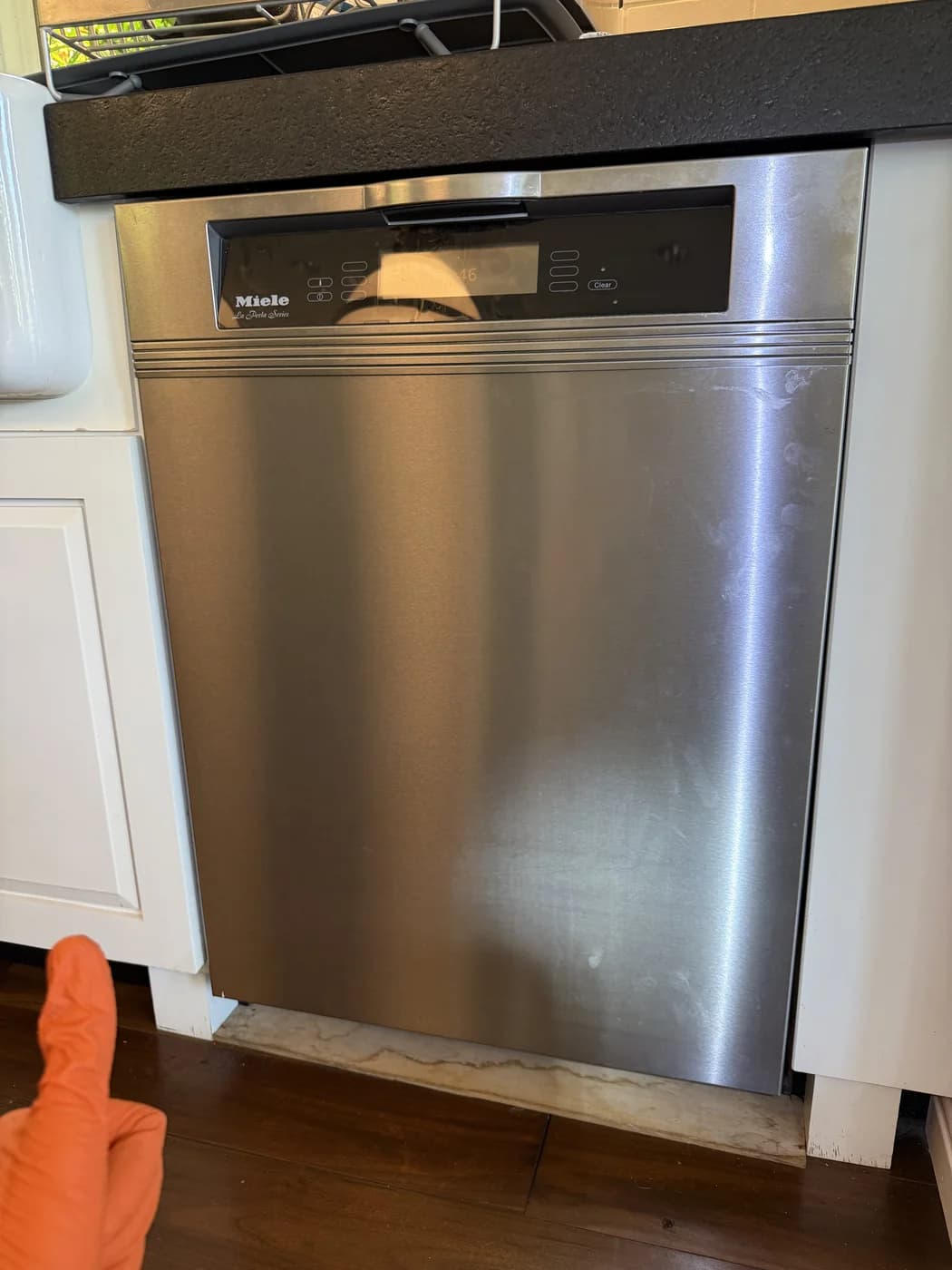

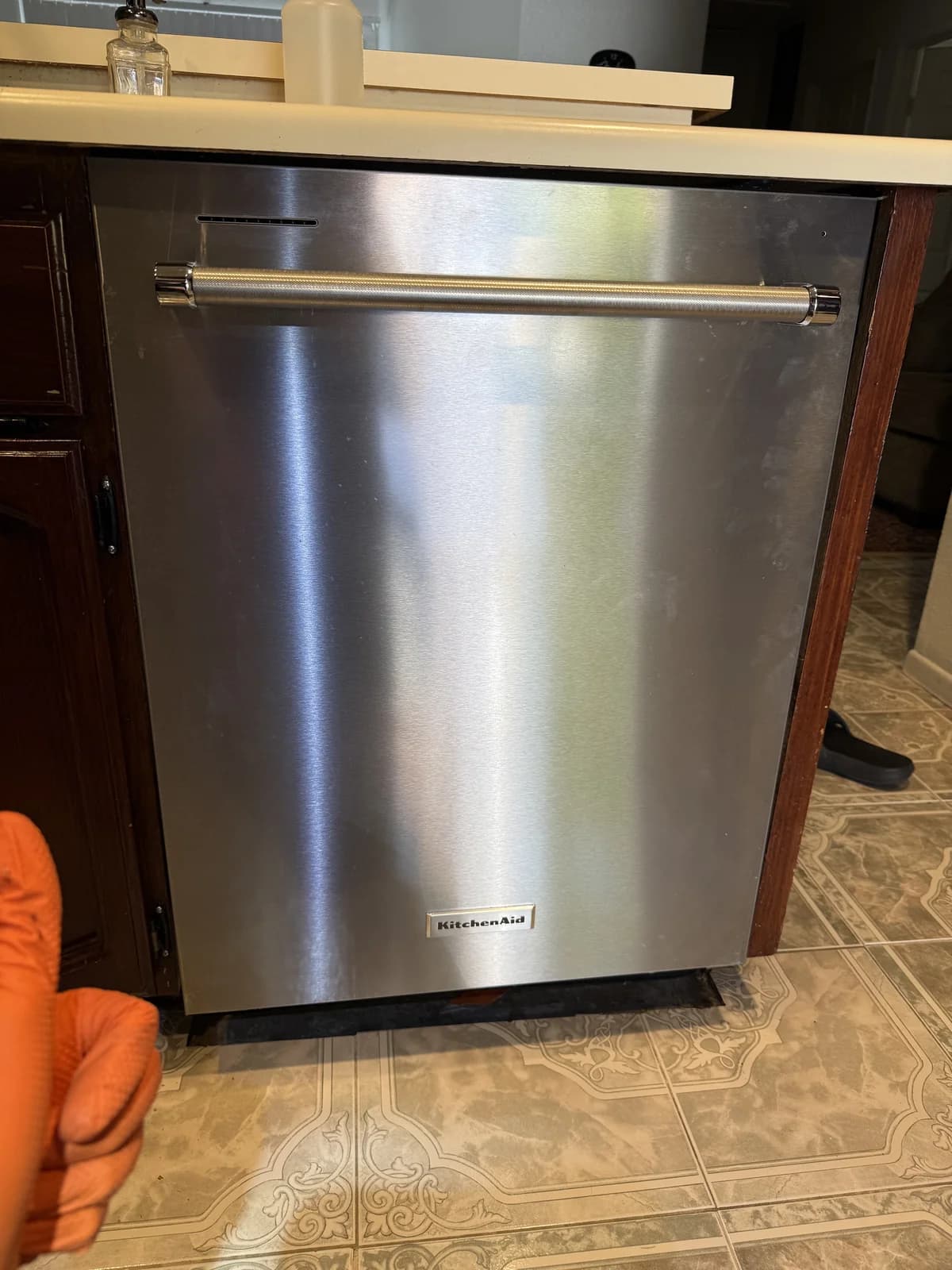
Real dishwasher service access points — the filter assembly, spray arms, and door gasket where most maintenance issues hide.
A Standing-Water Saturday Morning
A homeowner in Mt Helix opened her <a href="/brands/bosch">Bosch</a> 800-series dishwasher Sunday morning to standing water at the bottom of the tub. Not flooding — maybe a half-inch deep. The cycle had completed normally the night before. The dishes were clean. But there was water that shouldn't have been there, and a mild sour smell from the door seal.
Paul took the call. He suspected what most experienced techs would suspect first — not a mechanical failure, but a maintenance issue. The filter, the spray arm, or the drain hose loop. He talked her through the filter inspection over the phone. Twenty minutes later she called back to say she'd pulled out the lower filter and the mesh cup was nearly opaque with a layer of accumulated food debris, grease film, and what looked like calcium scale. She rinsed it under hot water with a soft brush. Ran a clean cycle. Standing water gone. No service call needed.
Half the dishwasher calls we field could have been avoided with monthly maintenance. The other half are real mechanical problems — pumps, valves, control boards. This piece is about the first half. What to do, how often, and what to do differently if you've got a Bosch versus a <a href="/brands/miele">Miele</a> versus a <a href="/brands/cove">Cove</a>.
The Maintenance Schedule We Actually Recommend
Manufacturer manuals tend to be overly conservative on cleaning intervals (so they sell more service contracts) or unrealistically rigid (so they sell more replacement parts). The real-world schedule we recommend based on a decade of high-end dishwasher service in San Diego:
San Diego specifically has moderately hard water — typically 200-300 mg/L (parts per million) of dissolved calcium and magnesium, which puts us in the 'hard' range on the USGS scale. Inland communities like <a href="/areas/escondido">Escondido</a> and Poway can run higher; coastal areas like <a href="/areas/la-jolla">La Jolla</a> and <a href="/areas/coronado">Coronado</a> are slightly softer because of different water-treatment paths. Hard water means more frequent descaling than dishwasher manuals from other regions assume.
- Filter: rinse every 1-2 weeks. Pull, look at it, rinse if it's visibly dirty. Takes 90 seconds.
- Spray arms: inspect monthly, deep-clean every 2-3 months. More often if you see white mineral specks on glasses.
- Door gasket: monthly wipe with a damp cloth. The horizontal channel at the bottom of the door traps debris worse than the vertical seal.
- Deep-clean cycle: monthly using a brand-recommended cleaner or white vinegar.
- Descaling: every 2-3 months in San Diego (vs. every 6 months in soft-water cities).
- Professional service inspection: annually for Bosch, Miele, Cove, Thermador — usually combined with another service call rather than a standalone visit.
The Filter — Your Single Most Important Maintenance Task
Most home dishwashers built since 2010 have user-cleanable filters at the bottom of the tub. Older units had self-cleaning macerator-style filters that broke food into small pieces and drained them out. High-end brands moved away from macerators because they're loud and they spray microplastic from softer foods around the tub. Modern Bosch, Miele, Cove, <a href="/brands/thermador">Thermador</a>, and <a href="/brands/kitchenaid">KitchenAid</a> dishwashers all use cleanable filters.
The filter is the most common cause of dishwasher complaints we see. It's also the easiest fix. Pull the lower rack out. Look at the bottom of the tub, behind or under the lower spray arm. You'll see a cylindrical filter assembly — usually two parts: a fine mesh outer cup and a coarse mesh inner cylinder. They twist apart, or pull straight up depending on the brand.
Rinse both parts under warm running water. Use a soft brush — old toothbrush works fine — to dislodge embedded debris. Don't use anything metal or stiff bristles; you can damage the mesh, and a damaged mesh means food bypassing the filter and ending up in the drain pump. That's how a $5 maintenance task turns into a $300 pump replacement.
Brand-specific filter notes worth knowing:
- <a href="/brands/bosch">Bosch</a> 300/500/800 series: two-part filter, twists counterclockwise to release. Models with the 'Crystal Dry' feature run hotter, which dries food residue onto the filter faster — rinse every 1 week.
- <a href="/brands/miele">Miele</a> G7000 series: triple-stage filter (coarse, fine, micro). All three pull out as a unit. The micro filter at the bottom is the one most homeowners miss. Rinse all three, reassemble in the same order.
- <a href="/brands/cove">Cove</a> DW2450: NSF-certified sanitization system means filter buildup affects sanitization performance, not just visible cleanliness. Monthly clean minimum.
- <a href="/brands/thermador">Thermador</a> Star Burner dishwashers (DWHD650, DWHD750): shares Bosch parent-company architecture, same filter design and cleaning procedure.
- <a href="/brands/kitchenaid">KitchenAid</a> KDPM and KDFE series: filter is at the bottom rear of the tub, partially under the heating coil. Be careful pulling — the coil can deform slightly with rough handling.
Spray Arm Cleaning — Where San Diego's Water Hits You Hardest
The spray arms distribute pressurized water around the tub during the wash cycle. They rotate freely on a center bearing, and each has small nozzles drilled along its length that direct water spray. When those nozzles clog, water pressure drops and dishes don't clean — even with a clean filter and a working pump.
In San Diego's water, nozzle clogging is almost always mineral buildup. Calcium and magnesium dissolved in the supply water deposit on metal and plastic surfaces over time. The nozzle holes are the smallest aperture in the spray path, so they clog first. You'll see this as: dishes coming out with white film on glasses, weak spray when you watch through the door window during a cycle, or specific rack zones that aren't cleaning as well as others.
Cleaning the spray arms:
If the nozzles are heavily clogged, soak the spray arm in white vinegar for 30 minutes before brushing. The acetic acid dissolves calcium deposits without damaging the plastic. Don't use commercial lime-removers (CLR, Lime-A-Way) on dishwasher parts — they're caustic enough to weaken plastic over multiple uses.
- Remove the lower spray arm (twists off counterclockwise on most models, or has a center retention clip)
- Check the upper spray arm — usually clips into a center hub or has a screw at the center
- Hold the spray arm up to a light and look through each nozzle hole
- Clear visible obstructions with a wooden toothpick or bamboo skewer (never metal — you'll scrape the nozzle interior)
- Soak in white vinegar 30 minutes for heavy mineral buildup
- Rinse thoroughly under running water
- Reinstall — spin by hand to confirm free rotation before closing the door
Door Gasket and the Forgotten Lower Edge
The rubber gasket around the door seals the tub during a cycle. It also traps food, grease, and soap residue along its surface — and the bottom of the door (the horizontal channel below the gasket) collects debris that doesn't get washed during cycles because it sits outside the wash chamber.
Wipe the gasket monthly with a damp cloth or microfiber. For stuck-on grime, an old toothbrush dipped in a vinegar-water mix (50/50) gets into the folds without damaging the rubber. Don't use bleach on rubber gaskets — chlorine degrades the polymer and shortens gasket life by years.
The bottom-of-door channel is the smell source most homeowners miss. Pull the door open and look at the horizontal strip at the bottom of the inner door panel. There's usually a quarter-cup of standing water down there after a cycle, and it doesn't drain through the regular wash cycle. Wipe it dry weekly. If you've ever opened your dishwasher to a faintly sour smell that's hard to trace, that channel is almost always the source.
Monthly Deep-Clean Cycle — Three Methods That Work
After you've cleaned the removable parts, run an empty hot cycle to dissolve residual buildup in the tub walls, hoses, and pump housing. Three methods we've tested across hundreds of service calls:
Andrew has a specific recommendation for high-end units: brand-specific cleaners are worth it. Bosch Machine Care Degreaser (and the equivalent for Thermador, which shares parent-company architecture), Miele IntenseClean tablets, and Cove's recommended cleaner are all formulated to dissolve food protein buildup that vinegar doesn't touch. For commodity dishwashers vinegar is fine; for high-end units the brand cleaner pays off in cycle quality.
- White vinegar (acidic, good for mineral buildup): pour 1 cup into a measuring cup on the top rack, run a hot cycle empty.
- Baking soda (alkaline, good for grease and odor): sprinkle 1/2 cup on the bottom of an empty tub, run a short hot cycle.
- Brand-specific cleaner (engineered for high-end units): one packet or tablet, run the manufacturer's recommended deep-clean cycle. Bosch Machine Care, Miele IntenseClean, Cove's cleaner all fit this category.
Descaling for San Diego's Hard Water
San Diego's water hardness varies by neighborhood. Inland (Escondido, Poway, Hidden Meadows) runs 280-340 mg/L on average. Coastal communities like La Jolla and Del Mar are softer because of how water is blended at treatment plants — typically 180-220 mg/L. South Bay (<a href="/areas/chula-vista">Chula Vista</a>) sits somewhere in between, around 220-260 mg/L.
For high-end dishwashers running in this water, descaling every 2-3 months prevents the gradual performance degradation that hard water causes. Symptoms of needed descaling:
Don't use heavy commercial descalers (the kind sold for coffee espresso machines or industrial equipment) — they're too aggressive and can damage rubber seals. Stick to dishwasher-specific descalers. Miele and Bosch both sell their own descaling powders calibrated for their machines; using the wrong product on a Miele can void warranty terms.
For dishwashers with built-in water softener reservoirs (most Miele, some <a href="/brands/asko">ASKO</a> models), keeping the salt reservoir filled is critical. Empty reservoir means the softener isn't softening water, which accelerates scale buildup throughout the dishwasher. Refill when the salt indicator on the front display turns on — usually every 4-8 weeks in San Diego.
- White or hazy spots on glassware after wash cycles
- White film coating the interior tub walls
- Weak spray pressure during cycles even after spray arm cleaning
- Water-flow error codes (Miele F11 family, Bosch E15) that resolve temporarily then return
Brand-Specific Maintenance That Matters
High-end dishwashers have unique features that require specific attention. The maintenance that extends a Bosch's life isn't the same that extends a Miele's. Quick brand-by-brand:
If you've followed all the maintenance above and your dishwasher still shows performance issues, the problem is mechanical — pump, valve, sensor, or control board. That's diagnostic territory, not maintenance. Our $90 flat diagnostic identifies which component, and the diagnostic fee applies toward the repair if you proceed.
- <a href="/brands/bosch">Bosch</a> 800-series and below: check the salt reservoir level monthly. Bosch Machine Care quarterly. Annual professional inspection of the drain pump impeller area — fragments from broken glassware accumulate there silently.
- <a href="/brands/miele">Miele</a> G7000 series: Miele IntenseClean monthly. Salt reservoir refill when indicator lights. AutoOpen drying users should check the door hinge dampers annually — they wear faster from repeated opening cycles.
- <a href="/brands/thermador">Thermador</a> DWHD650/750 (Sapphire and Emerald series): shares Bosch parent-company architecture. Same maintenance schedule as Bosch 800-series. The 'Star Burner' branding on the dishwasher is a marketing carryover from their range line — there are no burners in the dishwasher.
- <a href="/brands/cove">Cove</a> DW2450: NSF sanitization cycle should be run monthly even if not visibly needed — extended sit-time without high-temp cycles allows bacteria buildup in the sump. Monthly Cove cleaner runs.
- <a href="/brands/kitchenaid">KitchenAid</a> built-in panel-ready models: chopper blade area at the bottom center should be inspected annually for glass or hard-food fragments. KitchenAid's auto-cleaning feature works for soft food only — hard fragments build up regardless.
- <a href="/brands/asko">ASKO</a> DBI663IB and similar: Active Drying butterflies need monthly inspection — they're the soft silicone surfaces that protect fabric and dishes during the dry cycle. Lint and food fragments embed in them.
- <a href="/brands/fisher-paykel">Fisher & Paykel</a> DishDrawer (DD24 single, DD24DCS double): each drawer has its own filter assembly. Most owners only clean the lower drawer's filter and forget the upper. Monthly inspect both.
Monthly maintenance checklist
- Weekly: rinse the filter after a heavy load
- Monthly: wipe the door gasket and bottom door channel; run a deep-clean cycle
- Every 2-3 months: clean spray arm nozzles; descale (San Diego hard water)
- Quarterly: brand-specific deep cleaner (Bosch Machine Care, Miele IntenseClean, etc.)
- Annually: visual inspection of drain pump intake (if accessible); professional service inspection for high-end brands
When Cleaning Doesn't Fix It
If you've done all of the above and the dishwasher still has problems, the issue isn't maintenance — it's mechanical. Specific symptoms that point to service rather than DIY:
Most of these are repairable. The hardest part is knowing whether what you're seeing is maintenance-resolvable or repair-territory. The $90 diagnostic separates them cleanly. If we identify a maintenance issue you can fix yourself, we'll tell you that — and the diagnostic fee still applies as a credit toward any future repair work in the next 12 months.
- Water not draining after the cycle completes (filter and drain hose checked, still pooling) — drain pump or check valve issue
- Persistent sour or musty odor even after door gasket and filter cleaning — likely a fouled drain hose loop or sump area you can't easily access
- Error codes that recur after multiple resets — control board or sensor issue, not user-correctable
- Dishes still dirty after a full cycle (filter and spray arms confirmed clean) — pump pressure, heating element, or detergent dispenser issue
- Visible leaks from the door or bottom of the unit — gasket, hose, or pump seal failure
- Rust or corrosion visible inside the tub (rare on high-end stainless interiors, but happens with hard water plus chlorine wear)
- Dishwasher operating loudly compared to baseline — bearing wear or impeller damage
The Long View on High-End Dishwashers
A well-maintained Bosch 800-series or Miele G7000 should run 15-20 years before requiring significant mechanical repair. That's 5-7 times the lifespan of commodity dishwashers, but only if maintenance is consistent. Skipping monthly maintenance for 5+ years cuts that lifespan roughly in half because cumulative damage accumulates faster than it can be reversed.
If you've got a high-end dishwasher and you've been ignoring it, today is a fine day to start. Pull the filter, look at it, rinse it. Wipe the gasket. Run a cup of vinegar through a hot cycle. The whole sequence takes 15 minutes and pushes back the next service call by years.
If you've got a specific question about your unit, or you're seeing symptoms that maintenance isn't resolving, call us. Andrew handles most coastal and central calls; Paul covers Escondido, <a href="/areas/poway">Poway</a>, and the East County. We service all major high-end brands across San Diego.
Dishwasher Care — Real-World Reference
- Filter: Rinse every 1-2 weeks (more if Bosch CrystalDry user)
- Spray arms: Clear nozzles every 2-3 months; vinegar soak for mineral buildup
- Door gasket + bottom channel: Wipe monthly; bottom channel is the #1 odor source
- Deep-clean cycle: Monthly with vinegar, baking soda, or brand cleaner
- Descale: Every 2-3 months in San Diego (200-340 mg/L hard water)
- Service signal: Water not draining, recurring error codes, or leaks → (858) 788-7973
Related Reading
If your dishwasher has problems beyond what cleaning can fix, these guides cover the most common follow-ups.
If your dishwasher is still smelling, leaving residue, or leaking after you've gone through everything above — it's mechanical, not maintenance. Andrew (coastal and central San Diego) or Paul (Escondido, Poway, East County) usually get to same-day calls if you reach us before noon. (858) 788-7973, or book through the site.
(858) 788-7973